
How to Organize Important Papers at Home
A four-section home filing system borrowed from law offices, how long to keep tax records, pay stubs, warranties and vital records, and a cheat sheet to save.

Claire Fontaine
2026년 8월 1일 · 3분 분량
Dear kitchen drawer: you hold a car title, two expired warranties and a pay stub from three jobs ago, and nobody can find anything in you. Most homes have one. The fix is borrowed from law offices.
Below: a simple home filing setup, how long to keep each kind of paper, two lesser-known rules and a one-table recap for the fridge door.
The before
Here's what I started with: one overstuffed drawer, a tote bag of mail, and a tax folder that also held takeout menus. The worst part was that finding a single insurance policy took an evening.
The after
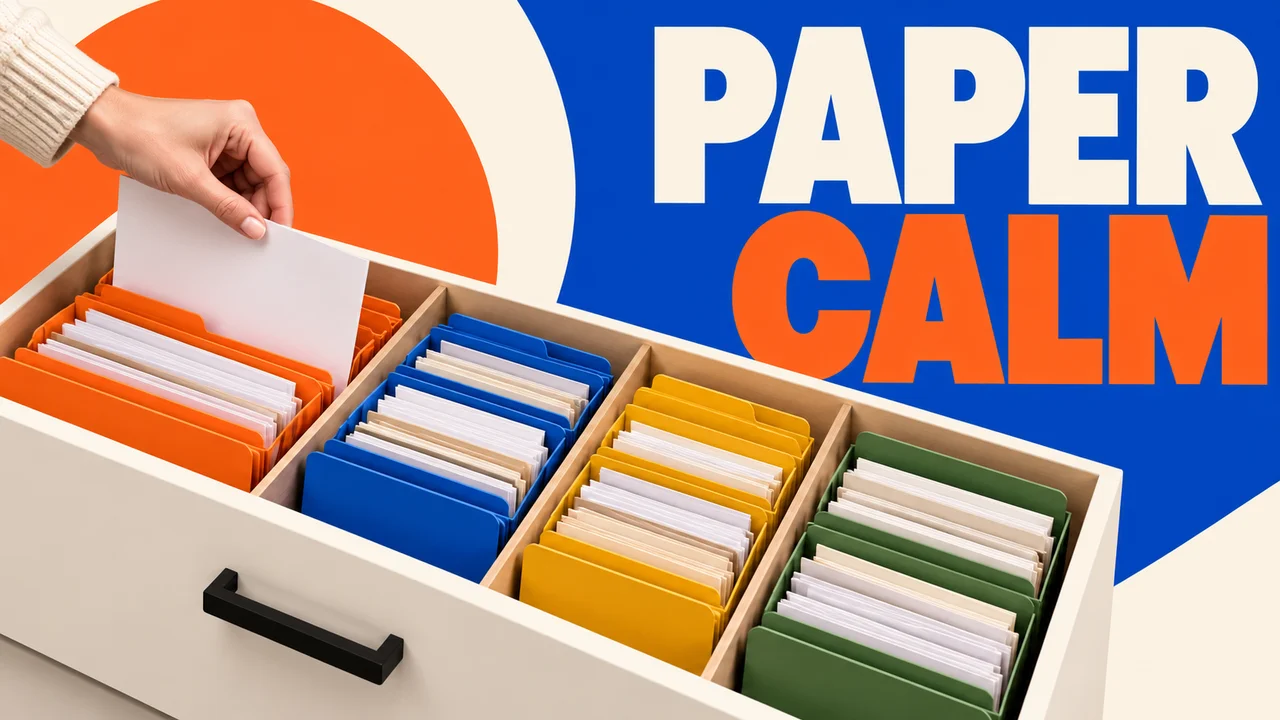
And here's where it ended up: four labeled sections, each folder marked with a date it can be shredded. People notice the color first; I notice that nothing is older than it needs to be. It is not a showroom; it is a box that answers questions.
Rewind: the plan
Rewind to the drawer. At the firm, files are sorted by status, not by topic, so I did the same at home. Four sections, four colors; past four, you are decorating, not organizing.
| Section | What goes in |
|---|---|
| Action | Unpaid bills, forms to sign, open claims |
| Reference | Taxes by year, home, car, insurance, medical, bank |
| Vault | Birth certificates, Social Security cards, passports, deeds, wills |
| Closed | Finished matters, each labeled "shred after" a date |
The Social Security Administration says to keep your card with your other important papers, not in your wallet.
Rewind: the work
Stage one was sorting every paper into those four piles plus a fifth: shred. It took two sessions. Tax receipts were everywhere.
Stage two was writing a "keep until" date on each folder tab, as a law office marks a closed file. My periods:
| Paper | Keep |
|---|---|
| Tax returns and supporting records | At least 3 years; many keep 7 |
| Pay stubs | Until they match your W-2 |
| Utility bills | About a month after paying, unless deductible |
| Warranties | As long as you own the item |
| Insurance policies | While the policy is active |
| Vital records | Permanently |
The IRS baseline is three years, but it rises to six if income was underreported by more than 25%, and seven for a worthless-securities or bad-debt claim.
Hidden tip 1: receipts for home improvements are not "old" paperwork. The IRS says to keep property records until the limitation period expires for the year you sell the property, because they help figure your gain. A new roof receipt can matter decades later.
Hidden tip 2: monthly investment statements usually do not need to be kept once the year-end summary arrives, according to FINRA. Keep the summary and the 1099s.
Stage three: the FTC recommends shredding papers with personal information before throwing them away; no shredder means a marker over account numbers.
The bill
- Effort: three sessions, start to finish.
- Spend: modest; hanging folders, a file box and a basic shredder.
- What went wrong: I shredded a pay stub before the W-2 arrived; luckily, it matched.
- What you can skip: fancy labels; a pencil on the tab works.
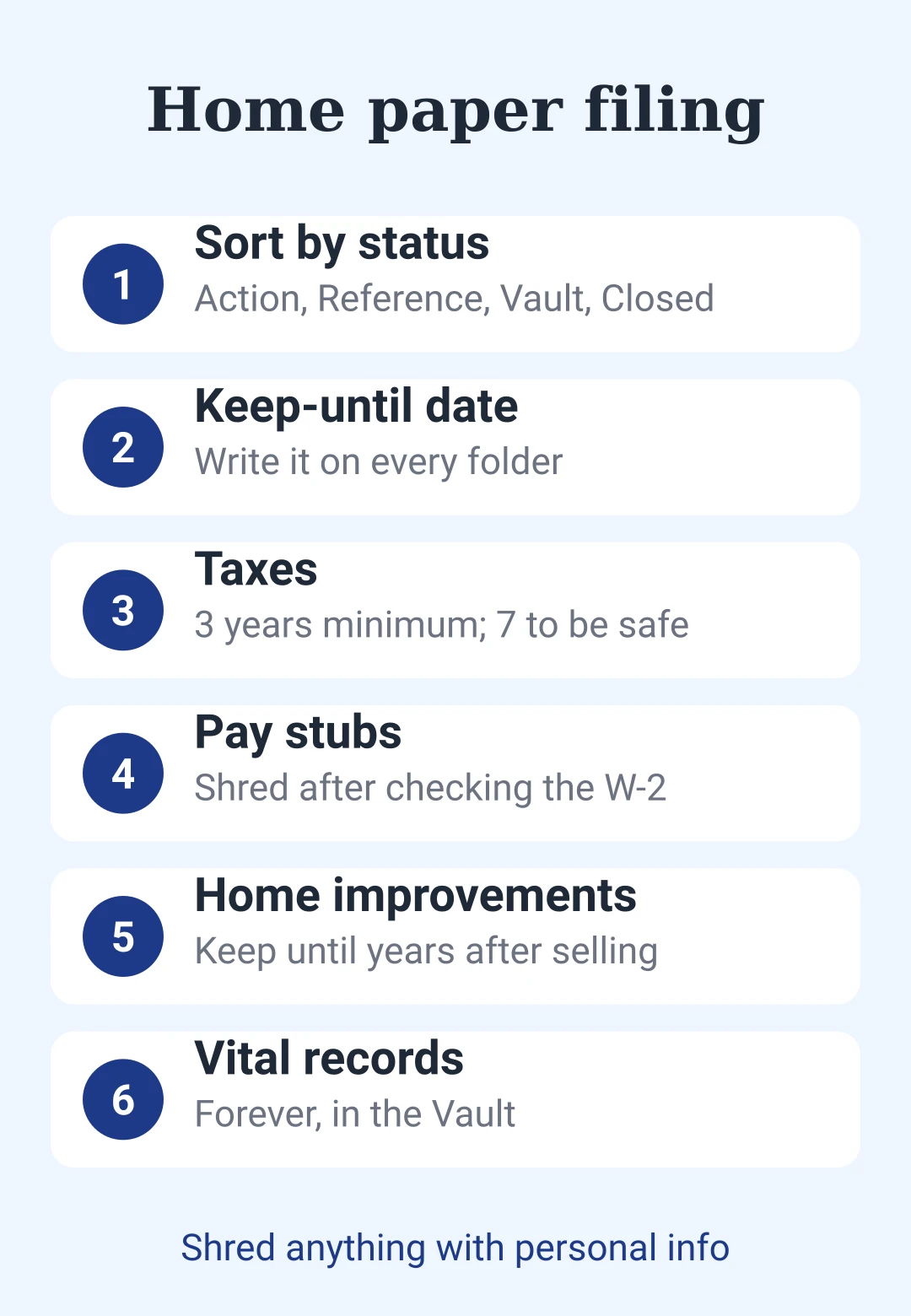
Cheat sheet: home paper filing
| Rule | Do this |
|---|---|
| Sort by status | Action, Reference, Vault, Closed |
| Colors | Four at most |
| Every folder | Write a "keep until" date |
| Taxes | 3 years minimum; 7 to be safe |
| Pay stubs | Shred after checking the W-2 |
| Home improvements | Keep until years after you sell |
| Monthly statements | Toss once the annual summary arrives |
| Vital records | Keep forever, in the Vault |
| Discards | Shred anything with personal info |
The after will not stay after forever; one sweep of the Closed section each year is what keeps it there.











댓글을 남기려면 해 주세요.
불러오는 중…