
🧸 How to Set Up a Safe Play Space for Your Baby
A field guide to the six floor-level hazards to clear before your baby's floor time, how to spot each one, two lesser-known safety tips, and a pocket card to save.

Anna Kowalski
2026년 6월 16일 · 3분 분량

You spread a blanket on the living-room floor, set your baby down on their tummy, and wonder what else is down there. Ask a few parents and the same short list of culprits comes up.
Here is a field guide to them: how to spot each one, where it hides, and what to clear first.
Habitat: where floor hazards live
You'll find them in the wild under sofa cushions, along baseboards and behind the TV stand. Six kinds cover nearly everything a baby meets. The goal: a blanket on a clear area of floor, as the US Safe to Sleep campaign puts it.
How to identify them: get down low
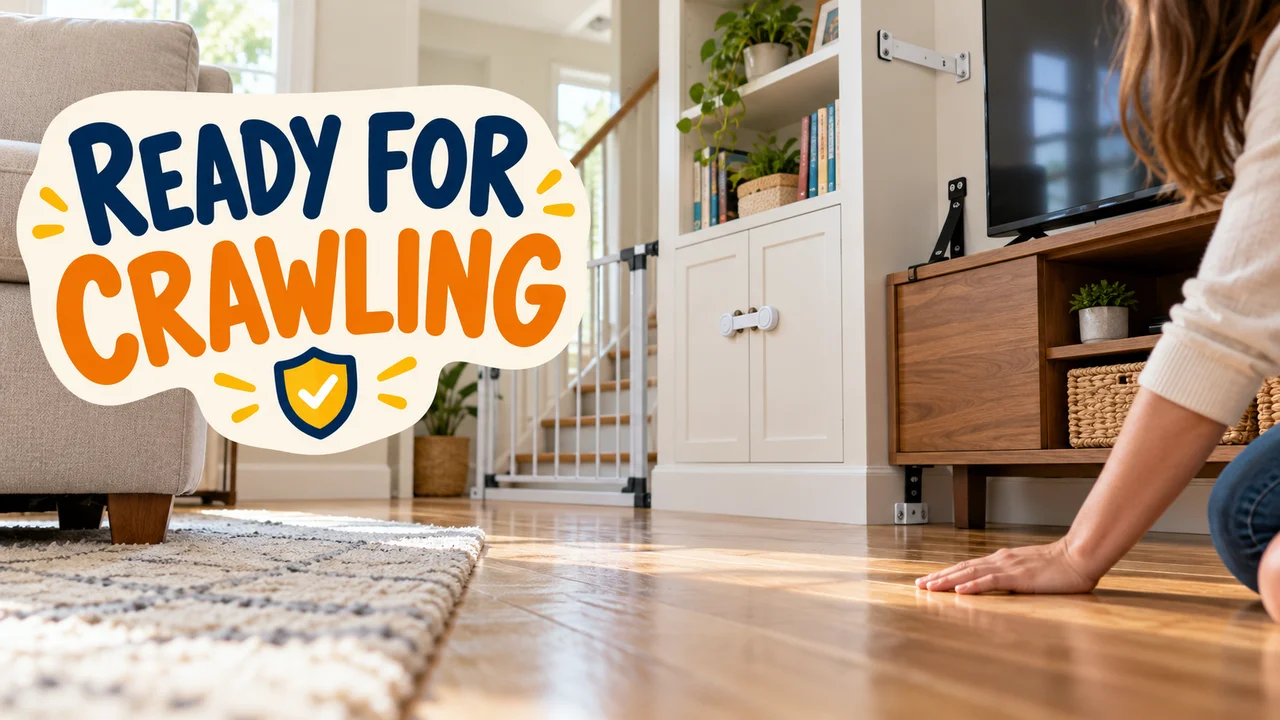
Hidden tip: crawl the room on your hands and knees, as St. Louis Children's Hospital suggests, to see what your baby sees. Look for three field marks:
- anything small enough to fit inside a toilet-paper roll
- anything that dangles or loops
- anything tall that could tip
The six species
Small parts
Field marks: fits inside a toilet-paper roll. The Canadian Paediatric Society treats that as a choking hazard. Found: under cushions, in older siblings' toys. Do: test anything doubtful. I keep a small-parts tester tube on my keyring for exactly this.
Button batteries
Field marks: a flat, shiny disc. Found: remote controls, watches, flashlights, hearing aids, toys. Behaviour: Health Canada says a swallowed one can cause severe internal burns in as little as two hours. Do: keep loose-door devices up high. Suspect swallowing? Go to emergency immediately.
Strong magnets
Field marks: small, powerful, often in sets. Behaviour: two or more swallowed can pull together through the intestines, and Health Canada notes there may be no signs of distress for days. Do: keep them out of reach; get medical help right away if swallowing is suspected.
Dangling cords
Field marks: blind cords, chargers, lamp cables. Do: secure blind cords high with a cleat and keep climbable furniture away from windows (Health Canada). Quebec's public health institute caps toy and clothing cords at 20 cm.
Tip-overs
Field marks: tall, top-heavy furniture and TVs. Health Canada reports that more than 70% of TV tip-over incidents involve children aged one to three. Do: anchor furniture to the wall, into a stud where possible, and set TVs far back on low, stable furniture.
Plastic bags and balloons
Field marks: thin, soft, crinkly. Do: knot used bags and store them up high; keep balloons and popped pieces out of reach.
Look-alikes
Commonly confused: coins and button batteries, both small, round and shiny. Pick up every disc. Hidden tip: a "dead" battery is not a safe one. Health Canada warns that even used batteries are dangerous, so dispose of them promptly.
Rare sighting: the sleeping baby
Floor time is for awake, supervised babies. Health Canada says every sleep, naps included, belongs on the back in a crib, cradle or bassinet. If your baby dozes off on the mat, move them.
Pocket card: clear these first
| Hazard | Quick rule |
|---|---|
| Small parts | Fits a toilet roll? Remove it |
| Button batteries | Off the floor; even used ones |
| Magnets | Out of reach; swallowed = doctor |
| Cords | Tied up high; toy cords 20 cm max |
| Furniture, TVs | Anchored to the wall |
| Bags, balloons | Knotted and stored up high |
| Sleepy baby | Move to crib, on the back |
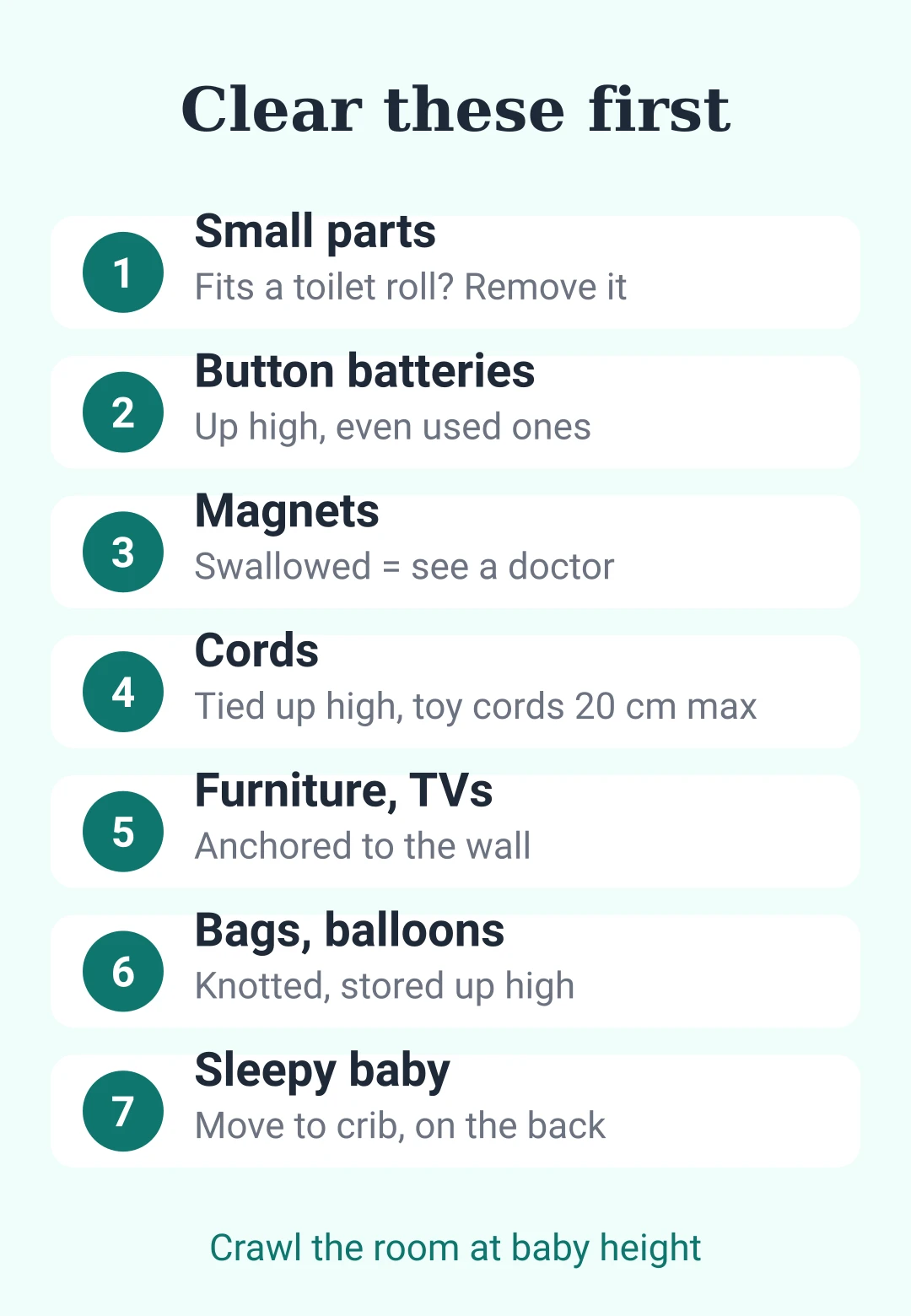
Keep the pocket card handy. A clear floor does more for little hands than any baby gadget.







댓글을 남기려면 해 주세요.
불러오는 중…