
Houseplant Watering Basics: How Much and How Often 🌱
How to tell when a houseplant needs water, how much to give, and how to read the signs of over- and under-watering, with a cheat sheet to save.

Margaret Evans
2026年9月8日 · 3分で読めます
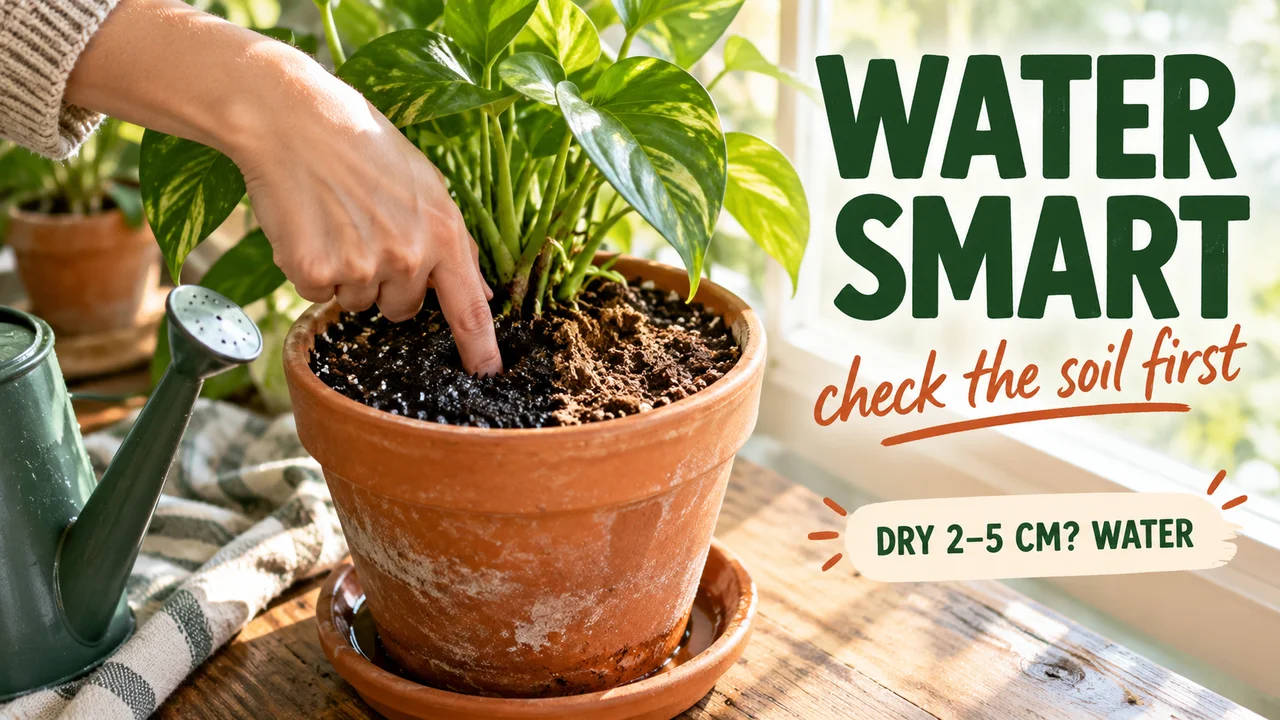
Most of us have stood over a drooping houseplant with the watering can, unsure whether it's thirsty or drowning. The pot holds the answer, if you know where to look.
Here's how to tell when a plant needs water, how much to give, and how to read the signs of too much and too little.
On the bench: one ordinary potted plant
Leaves, compost, a pot, a saucer, perhaps a pretty outer pot. Each layer tells you something about water.
Layer 1: the leaves
Hold a leaf to the light and look at the edges. Brown, crisp edges often point to too little water. Yellowing lower leaves that drop, or a plant that simply collapses, more often point to too much.
Wilting is the trickster. It happens both ways, so never water a wilting plant until you've felt the compost.
Layer 2: the top of the compost
Push a finger in. If it's still damp, wait. If it's dry an inch or two down (about 2–5 cm), water. Not sure? Leave it another day.
Layer 3: the pot
- Weight. Lift it straight after watering and remember the feel. A dry pot is noticeably lighter.
- Material. Unglazed terracotta loses water through its walls, so it dries faster than plastic or glazed pots.
- Room. A plant in a cool room needs water less often than one in a warm room.
Layer 4: the drainage hole and saucer
A pot should always have a hole. When you water, wet the whole root ball, not just the top: keep pouring slowly until water runs out of the bottom. Use room-temperature water; cold water can harm roots.
Then empty the saucer once it has finished draining, within about an hour. Roots need air, and standing water fills the air spaces in the compost. If water stops coming through, poke the hole with a pencil; they do get blocked.
The part nobody checks: the outer pot
That decorative outer pot hides a puddle. The roots can stand in it for days, out of sight. Lift the inner pot out after watering and tip away whatever has collected.
Hidden tip: a plant that wilts while its compost is wet isn't asking for water. Waterlogged roots get damaged and can't carry water up to the leaves. Ease it out of the pot: healthy roots are pale and firm, rotten ones dark and soft. I saw the same rule on the wards; the obvious symptom doesn't always mean the obvious cause.
Ignore the calendar
"Water once a week" sounds tidy, but light, warmth, pot and compost all change how fast a pot dries. My kitchen calendar has sowing dates on it, not watering days. Check the pot, not the date.
Hidden tip: when water runs straight through
Compost left very dry shrinks away from the sides, and water shoots down the gap and out of the hole without soaking in. Stand the pot in a bucket of water up to just below the rim and leave it until the top feels moist, then let it drain well.
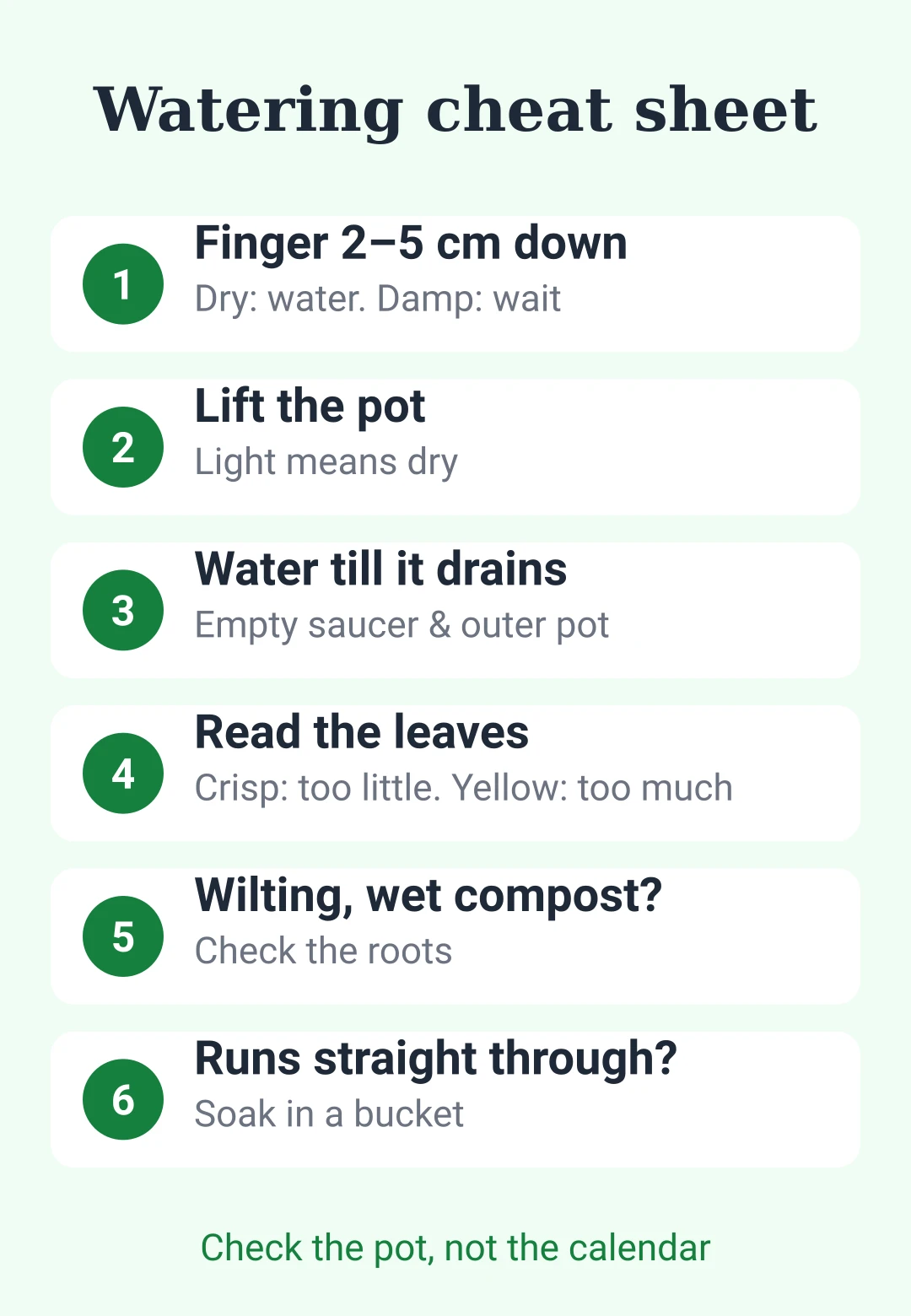
Save this: watering cheat sheet
| Check | What it tells you |
|---|---|
| Finger 2–5 cm down | Dry: water. Damp: wait |
| Lift the pot | Light: dry. Heavy: wet |
| How much | Until it runs out the bottom |
| Saucer and outer pot | Empty within an hour |
| Brown, crisp edges | Possibly too little |
| Yellow, dropping leaves | Possibly too much |
| Wilting in wet compost | Roots in trouble: check them |
| Water runs straight through | Soak in a bucket |
Every pot dries at its own pace; read the pot and you won't need the calendar.











コメントするにはしてください。
読み込み中…