
How to Read More Books: 10 Practical Tips
Ten realistic tips to read more books, set as a ten-try reading challenge, with simple ways to track your progress and a cheat sheet to save.

Elliot Shaw
17 de septiembre de 2026 · 3 min de lectura

The book on your bedside table has sat at page 43 so long its bookmark has gone soft, and it would like a word. It wants a plan, not more willpower.
Here it is as a dare: ten short tries, one tip per try, and a simple way to track your progress.
The dare
Read for twenty minutes, ten tries in a row, adding one tip each time. You need a book, an index card and a pencil. By try ten, reading should feel like a return, not a chore.
Ground rules
- A try counts if you read for twenty minutes, in any format; audiobooks included.
- Choosing what to read doesn't count.
- Miss one? The next session is the next try. No starting over.
Tries 1 to 3: make room
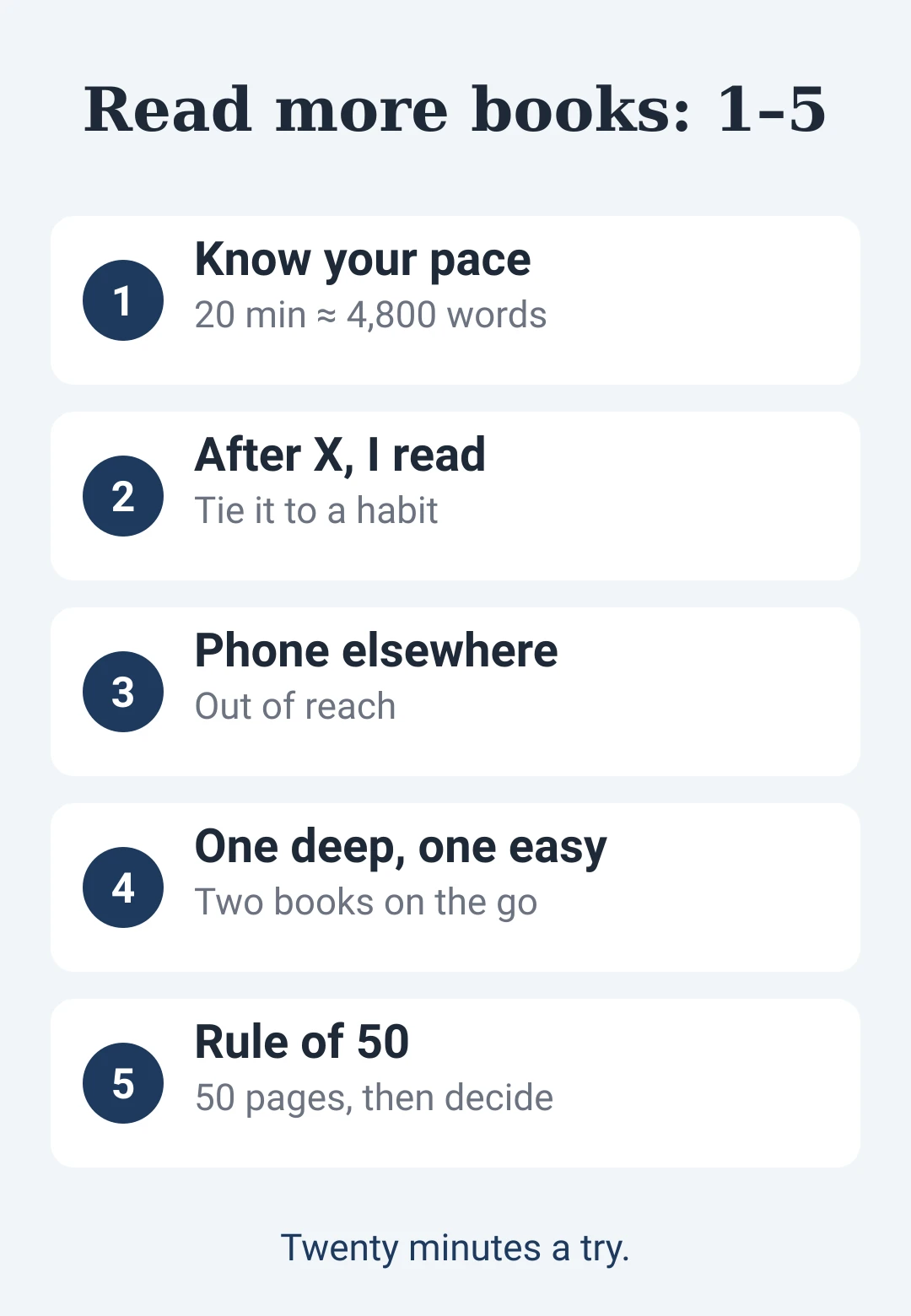
- Know your pace. The average adult reads non-fiction silently at about 238 words a minute (fiction, about 260), so twenty minutes covers roughly 4,800 words.
- Tie it to a habit you already have. "After I put the kettle on, I read." A large review of 94 tests found such if-then plans clearly improve follow-through.
- Park the phone elsewhere. Out of reach beats face down.
Hidden tip: on a Kindle, set reading progress to "Time left in chapter". It learns your own speed, and "six minutes left" is far easier to start than "chapter twelve".
Check-in after try three: did the minutes drag? Suspect the book before yourself.
Tries 4 to 6: read smarter
- Keep one deep, one easy. A demanding book for when you are fresh, a light one for when you are not.
- Use the Rule of 50. Hidden tip from librarian Nancy Pearl: give a book 50 pages; if you are over 50, read 100 minus your age. Not gripped by then? Stop, without guilt.
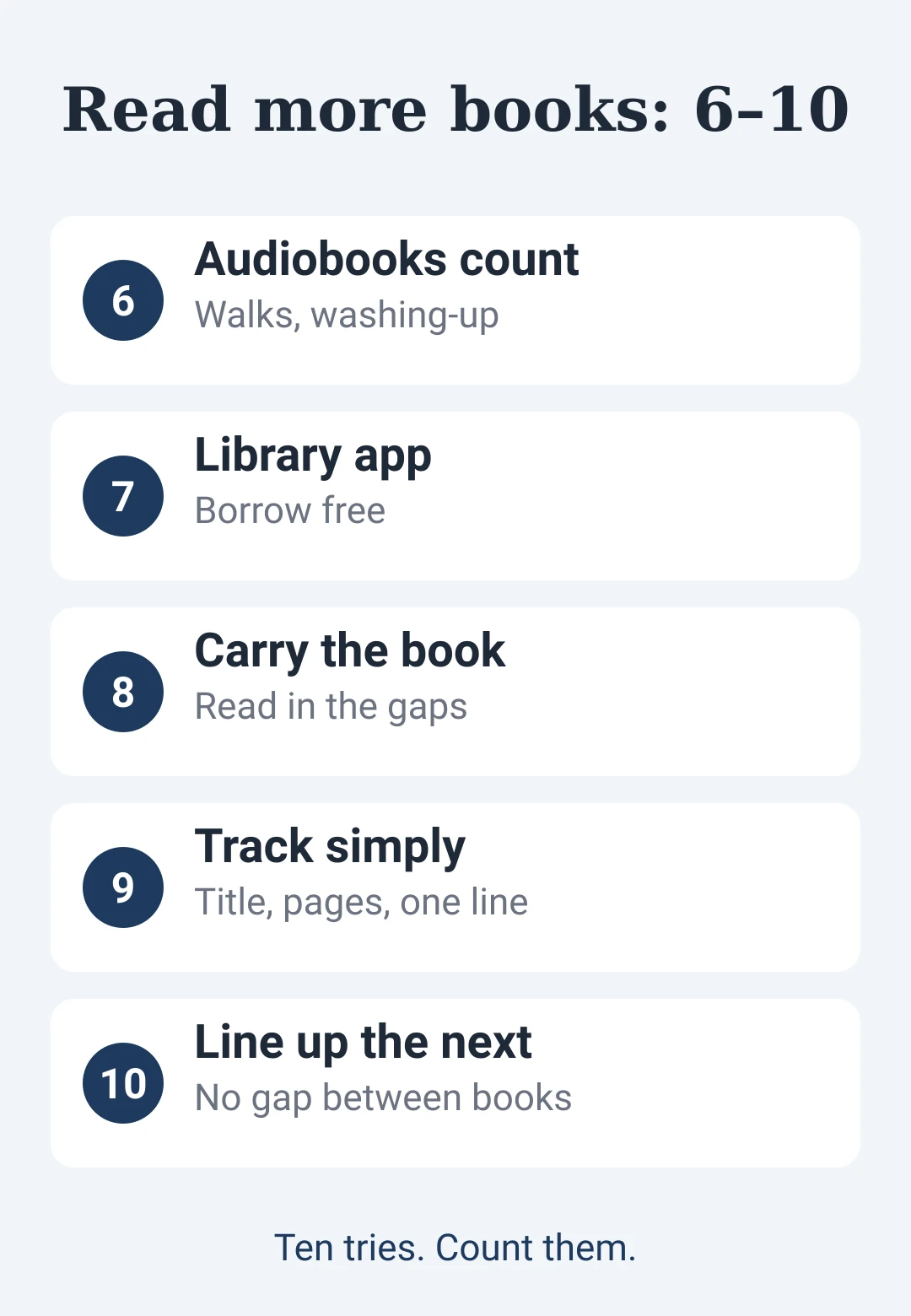
- Let audiobooks count. Researchers testing a non-fiction chapter (2016) found that listening to it gave the same understanding as reading it on an e-reader.
The wobble
Around try five, it will feel like a chore. Usually that is the middle of a book sagging, not your habit failing. Spend one try on the easy book. It still counts.
Tries 7 to 10: make it stick
- Use your library's app. Libby, from OverDrive, lets you borrow ebooks and audiobooks free with a library card.
- Carry the book everywhere. Queues and train journeys add up.
- Track it simply. On the card: title, pages read, one line about it. I keep a card and pencil in every book; the least glamorous tracker in Oxford, and the most reliable. StoryGraph lets you mark a book "Did not finish" and still count its pages.
- Line up the next book. Choose it before finishing this one, so the habit has no gap to fall into.
Finish line
On try ten, compare your card with try one: pages per session. If they rose, level two is thirty minutes; if not, five more tries before blaming the book. Report back with your count.
Cheat sheet
| Tip | Do this |
|---|---|
| 1. Pace | 20 min ≈ 4,800 words |
| 2. Anchor | "After X, I read" |
| 3. Phone | Out of reach |
| 4. Pair | One deep, one easy |
| 5. Rule of 50 | 50 pages, then decide |
| 6. Listen | Audiobooks count |
| 7. Library app | Borrow free |
| 8. Carry | Read in the gaps |
| 9. Track | Title, pages, one line |
| 10. Next book | Pick it before finishing |











para dejar un comentario.
Cargando…