
How to Help a Shy or New Cat Settle In: Safe Room Setup 🐈
Nora Lindqvist · 58 次观看 · 3个月前 · 文章

A safe room checklist (hiding spots, litter, food, scent) and five steps with check-ins that take a nervous cat from under the bed to greeting you at the door, plus a cheat sheet to save.
A new cat slips out of the carrier and vanishes under the bed, and you end up on the floor wondering what you did wrong. Nothing, most likely; she needs a smaller world first.
The challenge: one safe room, five steps, until she eats, plays and greets you at the door.
Here are the checklist, the steps and a cheat sheet.
The safe room checklist
- Room: small and quiet, with a solid door. A spare room or bathroom, not the laundry room.
- Hides: a box on its side or a covered bed. Block gaps under and behind furniture.
- Bowls: near her bed, away from the litter box.
- Litter box: apart from the bowls, but close enough to her hide that the trip feels safe.
- Safety: windows shut; cords, small objects and toxic plants out.
Once it's set, don't move things.
Ground rules
- Never pull her out of hiding. In my experience, forcing it only adds time.
- Her behavior sets the pace. Move on once you've seen a step's sign twice.
- Slipped back? Return to the last good step.
- Not eating at all for a day or so? Call your vet; a cat that stops eating can develop liver trouble, and a new home is a known trigger.
Step 1: Be furniture
Visit at the same times each day, knock before opening the door, and sit low with a book or knitting. Check-in: she eats, drinks and uses the box, even if only while you're out.
Step 2: Talk with your eyes
When she looks at you, narrow your eyes, close them slowly, then glance away. Check-in: she blinks back.
Hidden tip: in a 2020 study in Scientific Reports, cats approached even an unfamiliar person more readily after slow blinks than after a neutral face.
Step 3: Play at a distance
Use a wand toy so she can chase without nearing your hands, and set treats beside her hide. Check-in: she plays or eats with you there.
This is where she comes out one visit and hides the next, and it can feel as though all the patience you've spent has gone straight back under the bed, which it hasn't, because she is still learning that the room stays the same. So keep it the same.
Step 4: Let her come to you
Hold a finger at nose height and let her decide. Check-in: she rubs against you more than once.
Step 5: Open the door
Check the next room for hazards, then leave the safe room open so she can retreat. Check-in: she explores and comes back on her own.
Hidden tip: the plain cardboard box matters. In a 2014 shelter study, newly arrived cats given a hiding box showed lower stress scores in their first days than cats without one.
Finish line
She eats in front of you and meets you at the door, tail up. Weeks is normal; shelters use a rough rule of three days to decompress, three weeks to settle, three months to feel at home.
My Oskar began behind a box of yarn.
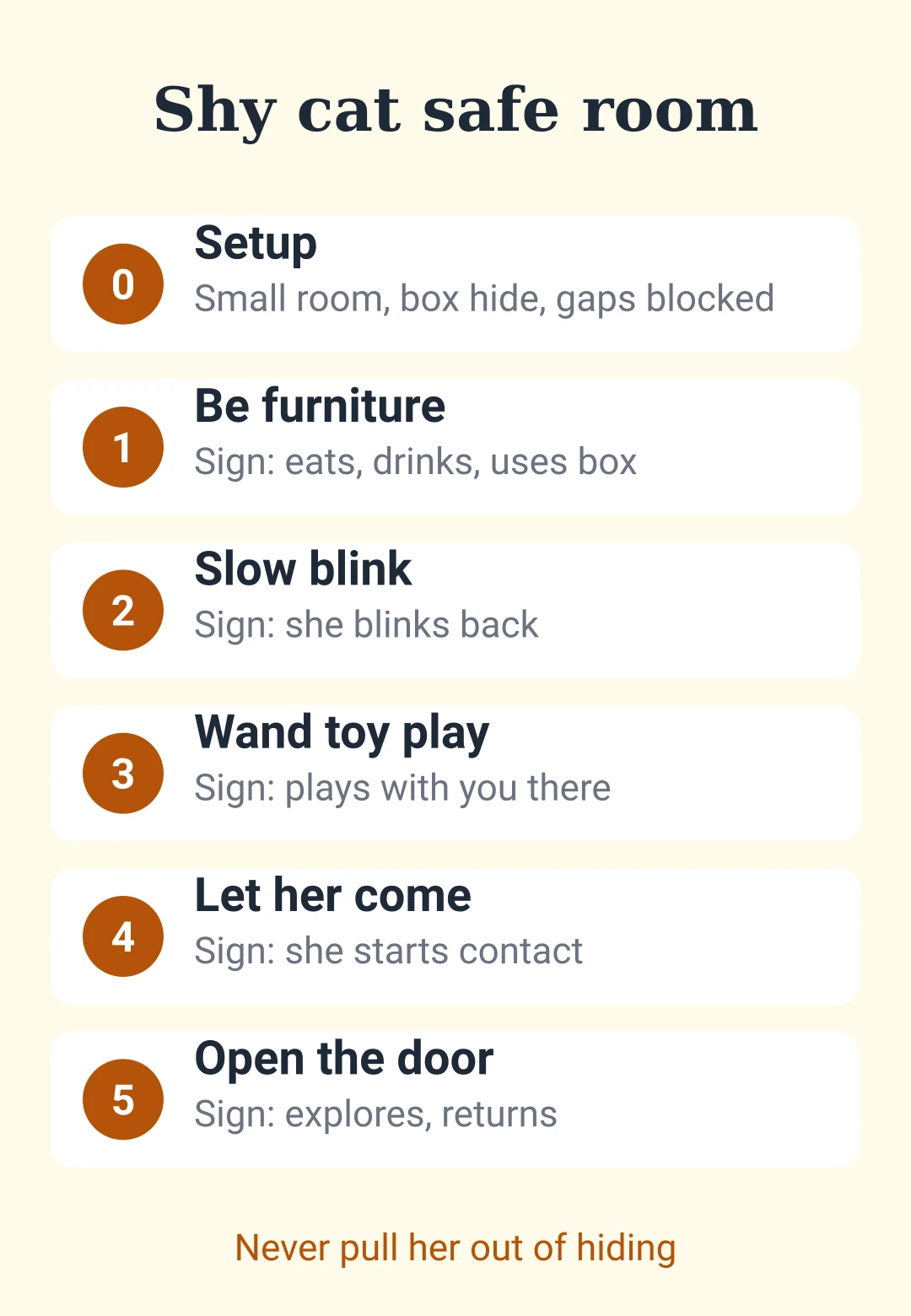
Cheat sheet: save this
| Step | Do | Move on when |
|---|---|---|
| Setup | Small room, box hide | Nothing moves |
| 1 | Same times, knock, sit low | Eats, uses box |
| 2 | Slow blink | Blinks back |
| 3 | Wand toy, treats | Plays near you |
| 4 | Finger at nose height | She starts contact |
| 5 | Door open | Explores, returns |
Tell me in the comments which step took longest. Level two, with other pets: after her first week, swap a sock rubbed on her cheeks.
- shy cat
- new cat
- cat safe room
- foster cat
- cat adoption
- cat behavior
- slow blink
- cat hiding
喜欢这篇帖子吗?
后即可发表评论。
加载中…