
How to Remove Grass and Mud Stains: A Step-by-Step Guide
Kevin Brooks · 38回視聴 · 2 か月前 · 記事
Five steps that lift grass and mud stains without setting them: when to wait, what to pre-treat with, which water temperature to use, how to read the bleach symbol and how to check before drying.
Practice pants come home with green knees and a crust of mud, and the first move most of us make is a hot tap and a hard scrub. That move is the problem: heat, scrubbing wet mud and the dryer are what turn a fresh stain into a permanent one.
Below: the right order for grass and mud, which water temperature to use at each step, and how to check the stain is gone before anything goes in the dryer.
Step 1: Let mud dry, then brush it off
Hidden tip: leave wet mud alone. The American Cleaning Institute's stain chart says to wait until mud is dry, then brush off as much as you can. Mud's tiny particles don't dissolve, and rubbing them wet works them into the weave.
- Knock big clumps off outdoors.
- Brush the dry spot with a stiff brush, or scrape with the edge of a spoon.
- Grass is different: treat it right away, while it's fresh.
With three teenagers in the house, I keep a hook by the back door just for drying muddy pants. Biscuit the Lab adds his own paw prints for free.
Step 2: Pre-treat with the right thing
| Stain | Pre-treat |
|---|---|
| Grass | Enzyme stain remover or enzyme detergent, worked in gently |
| Light mud | Paste of powder detergent and water, or liquid detergent |
| Heavy mud | Presoak in detergent or an enzyme product |
Cover the stain and let it sit at least five minutes, longer for old stains. Don't rinse it off before washing. What stays on the spot keeps working in the machine.
Hidden tip: keep ammonia away from grass stains. University of Illinois Extension warns that alkaline products such as ammonia and some degreasers can set the plant dye in grass. And never mix ammonia with chlorine bleach. The fumes are hazardous.
Step 3: Get the water temperature right
| Stage | Water |
|---|---|
| Pre-treat or soak | Cool |
| Wash | Warmest the care label allows |
| Jeans and dark colors | Follow the label, often cold |
Hot water on an untreated grass stain can lock the color in. I'll say it plain: cool first, warm second.
Step 4: Bleach only if the label says so
If a shadow is still there, the cleaning institute's next step is bleach that is safe for the fabric. Read the triangle on the care tag:
- Plain triangle: any bleach is fine.
- Triangle with two diagonal lines: oxygen (non-chlorine) bleach only.
- Crossed-out triangle: no bleach at all.
Oxygen bleach is gentler on colors, but test it on a hidden seam first, and skip it on wool, silk, leather and dry-clean-only items. Chlorine bleach fades colors and weakens silk, wool and spandex.
Step 5: Check before it goes in the dryer
- Pull the item out as soon as the cycle ends.
- Look at the spot in daylight or under a bright lamp, front and back.
- Still see it? Repeat steps 2 to 4.
- Not sure? Hang it to air dry. Dryer heat sets stains.
What do you call a grass stain that won't leave? A lawn-term resident.
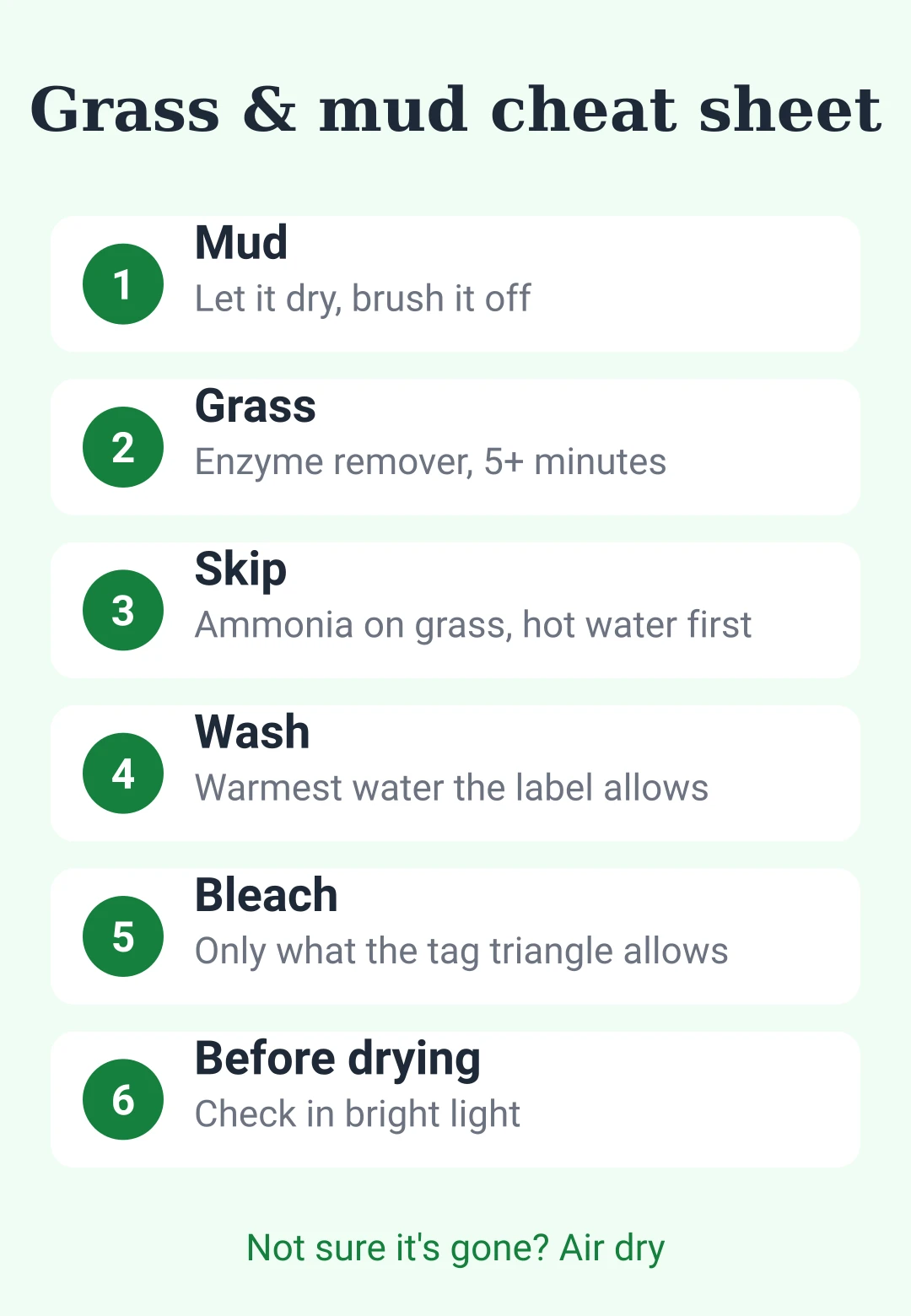
Save this: grass and mud cheat sheet
| Step | Do this |
|---|---|
| Mud | Let it dry, brush it off |
| Grass | Treat right away |
| Grass pre-treat | Enzyme remover, at least 5 minutes |
| Mud pre-treat | Detergent paste, or presoak if heavy |
| Skip | Ammonia on grass, hot water first |
| Wash | Warmest water the label allows |
| Bleach | Only what the tag triangle allows |
| Before drying | Check in bright light, air dry if unsure |
Bottom line: dry the mud, pre-treat cool, wash warm, and nothing hits the dryer until the stain is gone.
- grass stains
- mud stains
- stain removal
- laundry
- pre-treat
- oxygen bleach
- care labels
- kids clothes
この投稿はいかがでしたか?
コメントするにはしてください。
読み込み中…