
How to Make Scones That Rise: Common Mistakes to Avoid 🫖
Fiona MacLeod · 40回視聴 · 3 か月前 · 記事

A walk along the baking counter showing the common mistakes that keep scones flat, the fix at each stop, and a cheat sheet to save.
You slide a tray of scones out of the oven and find squat, pale discs instead of tall, golden ones. Nearly always, the cause is something small that happened on the way to the oven.
Walk my baking counter with me, left to right, five stops, and you'll see the common mistakes that flatten scones and the fix at each one.
Stop one: the pantry shelf
Flour and baking powder sit on the left. Most flat scones start right here.
- Mistake: scooping flour with the cup. A packed cup can hold up to 160 g, where recipes expect about 120 g. Extra flour means dry, heavy dough.
- Fix: fluff the flour, spoon it in, scrape it level. Or weigh it.
Hidden tip: the fizz test can fool you. America's Test Kitchen found year-old baking powder still bubbled in water, yet ten-month-old powder gave biscuits half the rise of fresh. Write the opening date on the can and replace it after six months.
Stop two: the fridge door
Butter and buttermilk live beside the counter, so they barely warm up.
- Mistake: soft butter. It soaks into the flour, then leaks out in the oven.
- Fix: very cold butter in 1 cm (half-inch) pieces, and cold liquid. In the oven those lumps melt, their water turns to steam, and the steam lifts the dough.
Stop three: the wooden board
The middle of the counter. A light hand matters most here.
- Mistake: mixing until smooth. Working the dough builds gluten, and the scones turn tough and dense.
- Fix: stir just until it holds, still shaggy, then pat it out gently.
Stop four: the cutter drawer
Under the board: a sharp round cutter and a bench knife.
- Mistake: twisting the cutter. The twist pinches the edges shut, so the sides can't climb.
- Fix: flour the cutter, press straight down, lift straight up. Knife-cut wedges work too.
Stop five: the freezer and the oven
At the far right, the freezer sits beside the oven on purpose. Hidden tip: freeze the shaped scones on their pan for about 30 minutes while the oven heats. The butter firms, the dough relaxes, and they rise taller.
Then bake hot, around 425°F (220°C), tops brushed with milk or cream for colour.
The spot that still lets me down
My oven runs cooler than its dial, and for years I blamed the recipe. Well, it was the oven. A thermometer on the rack showed it in one bake.
Save this: the scone rise cheat sheet
Looking back from the oven, one rule connects every stop: keep it cold, handle it little, cut it clean, bake it hot.
| Stop | Do this |
|---|---|
| Flour | Spoon and level, about 120 g a cup |
| Baking powder | Date the can, replace after 6 months |
| Butter | Very cold, 1 cm pieces |
| Liquid | Cold from the fridge |
| Mixing | Stop once it just holds |
| Cutting | Straight down, no twist |
| Before baking | Freeze 30 minutes |
| Oven | 425°F (220°C), checked with a thermometer |
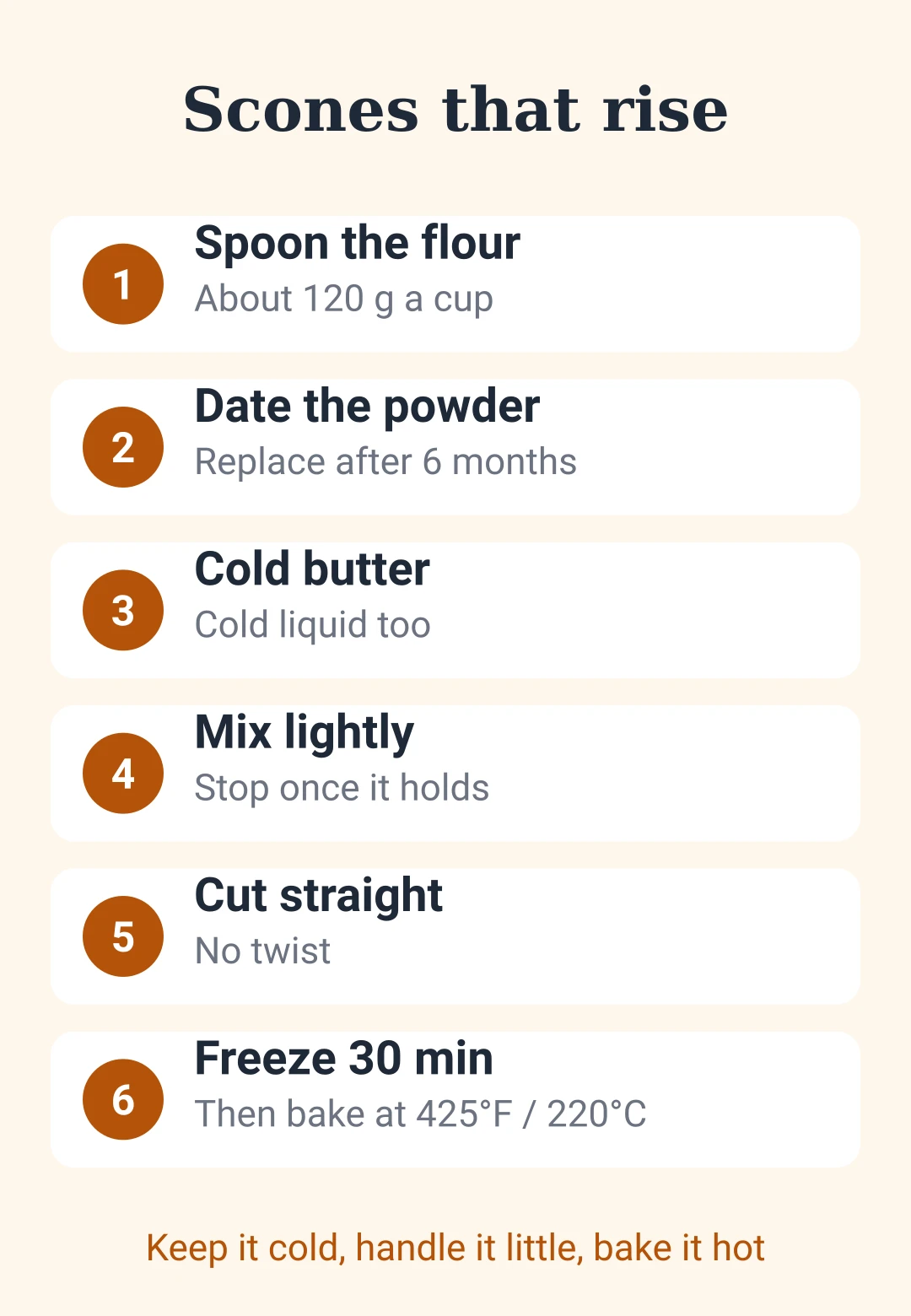
Walk your own counter in this order next batch, and ask at every spot whether it is cold enough and whether you are handling it too much.
- scones
- baking tips
- scone recipe
- cold butter
- baking powder
- how to measure flour
- home baking
- breakfast baking
この投稿はいかがでしたか?
コメントするにはしてください。
読み込み中…