
How to Treat Cuts, Burns and Scrapes at Home: First Aid Basics
Step-by-step care for minor cuts, burns and scrapes, the first aid label words in plain English, and the signs that mean it is time to see a doctor.

Tom Gallagher
2026年7月31日 · 2分で読めます
You nick a finger on a knife or brush a hot pan, open the first aid box, and the packets say "sterile non-adherent pad", "petrolatum" and "triple antibiotic". Half of that matters.
Here is step-by-step care for minor cuts, burns and scrapes, the label words in plain English, and the signs that call for a doctor.
Cuts and scrapes, step by step
- Wash your hands. Press a clean cloth or gauze on it for one to two minutes, or until bleeding stops.
- Rinse with cool or lukewarm water and mild soap.
- Add a thin layer of petroleum jelly.
- Cover with a sterile bandage. Change it daily until healed.
The American Academy of Dermatology (AAD) says moist wounds skip the scab, and scabbed wounds heal slower.
Minor burns, step by step
- Take off rings or anything tight near the burn before it swells, unless it is stuck.
- Hold it under cool running water for 10 to 20 minutes. Cool, not ice.
- Leave blisters alone.
- Cover with a nonstick sterile bandage and petroleum jelly. No butter, no toothpaste.
Label words, translated
- Laceration: a cut. Abrasion is the doctor's word for a scrape.
- Sterile: germ-free until the wrapper is torn.
- Non-adherent: will not stick to a wet wound. On a burn, this one matters.
- Petrolatum: plain petroleum jelly under its ingredient name.
- Triple antibiotic: an ointment with three antibiotics. The AAD advises skipping it on minor cuts, since it can irritate skin.
False friends
First-degree and superficial are the same burn in two costumes: only the top layer of skin. Second-degree and partial-thickness are one burn too, and it can blister.
Cool and cold differ too. MedlinePlus warns ice can injure burned tissue further.
The word that oversells
Back in my years behind the counter, the brown bottle of hydrogen peroxide drew more questions than anything else on the shelf, because people loved the fizz and took it as proof it was working. A Cleveland Clinic physician says it also damages healthy tissue and can slow healing. Soap and water do the job.
Hidden tip 1: use petroleum jelly from a tube, not a jar. The AAD says a tube limits contamination.
Hidden tip 2: the tetanus clock runs faster for dirty wounds. The CDC advises a booster if your last shot was five or more years ago, not ten.
When to see a doctor
- A cut longer than three-quarters of an inch or deeper than a quarter inch
- Bleeding that keeps going after 10 minutes of pressure
- A bite, or dirt that will not wash out
- A burn larger than 2 inches, on the face, hands, feet, groin or a joint, or from fire, chemicals or electricity
- Pus, spreading redness, warmth, a red streak or fever
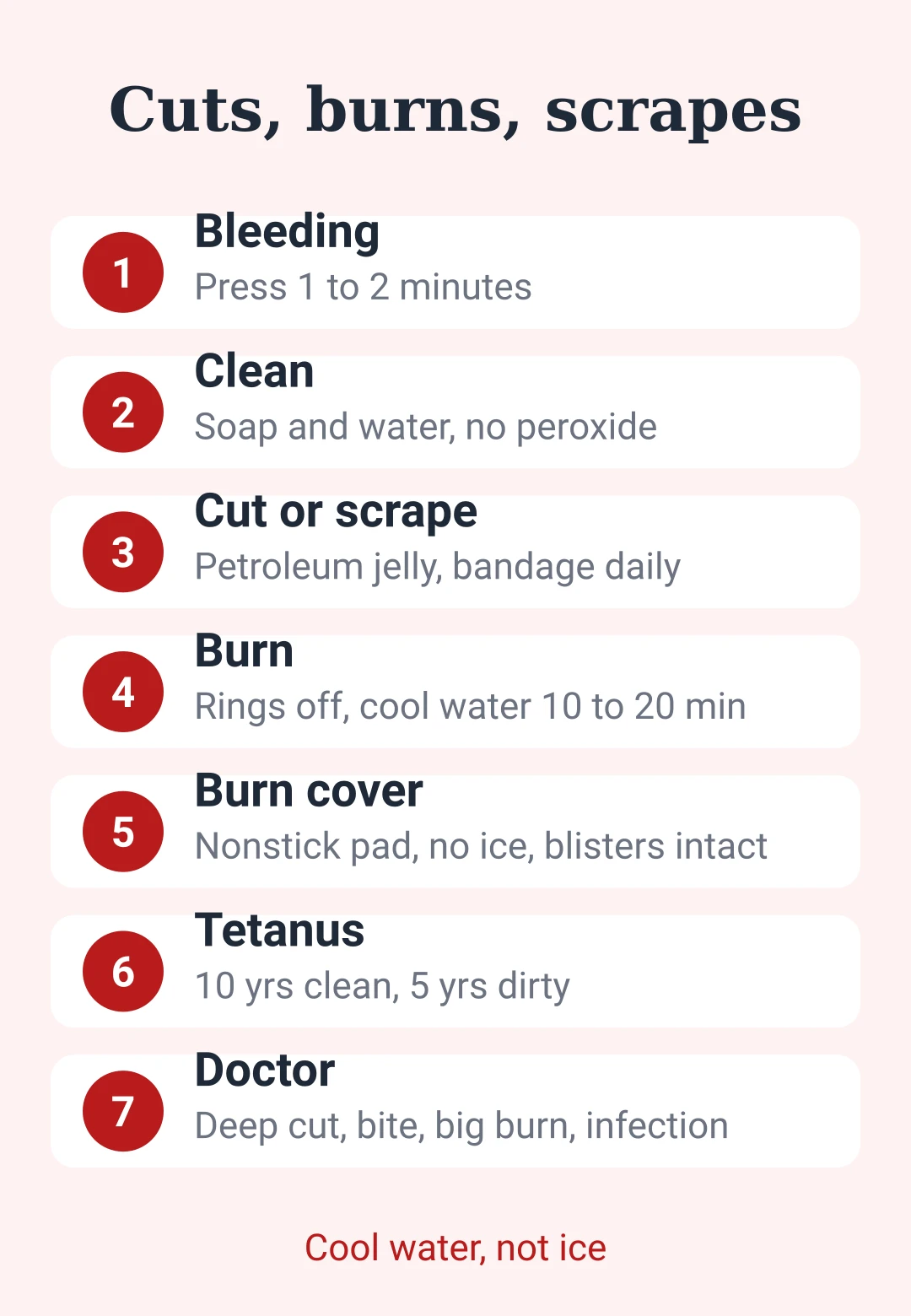
Cheat sheet: cuts, burns, scrapes
| Step | Do this |
|---|---|
| Bleeding | Press one to two minutes |
| Clean | Soap and water, no peroxide |
| Cut or scrape | Petroleum jelly, bandage, change daily |
| Burn | Rings off, cool water 10 to 20 minutes |
| Burn cover | Nonstick pad, blisters intact, no ice |
| Tetanus | 10 years clean, 5 years dirty |
| Doctor | Deep cut, bite, big burn, infection signs |
Learn five words, skip the fizz, and the box reads like plain English.




コメントするにはしてください。
読み込み中…