
How to Read a Nonfiction Book Faster and Remember More
A reading order historians use, eight book words translated into plain English, and a simple recall habit that keeps what you read, with a cheat sheet to save.

Elliot Shaw
2026年7月7日 · 3分で読めます
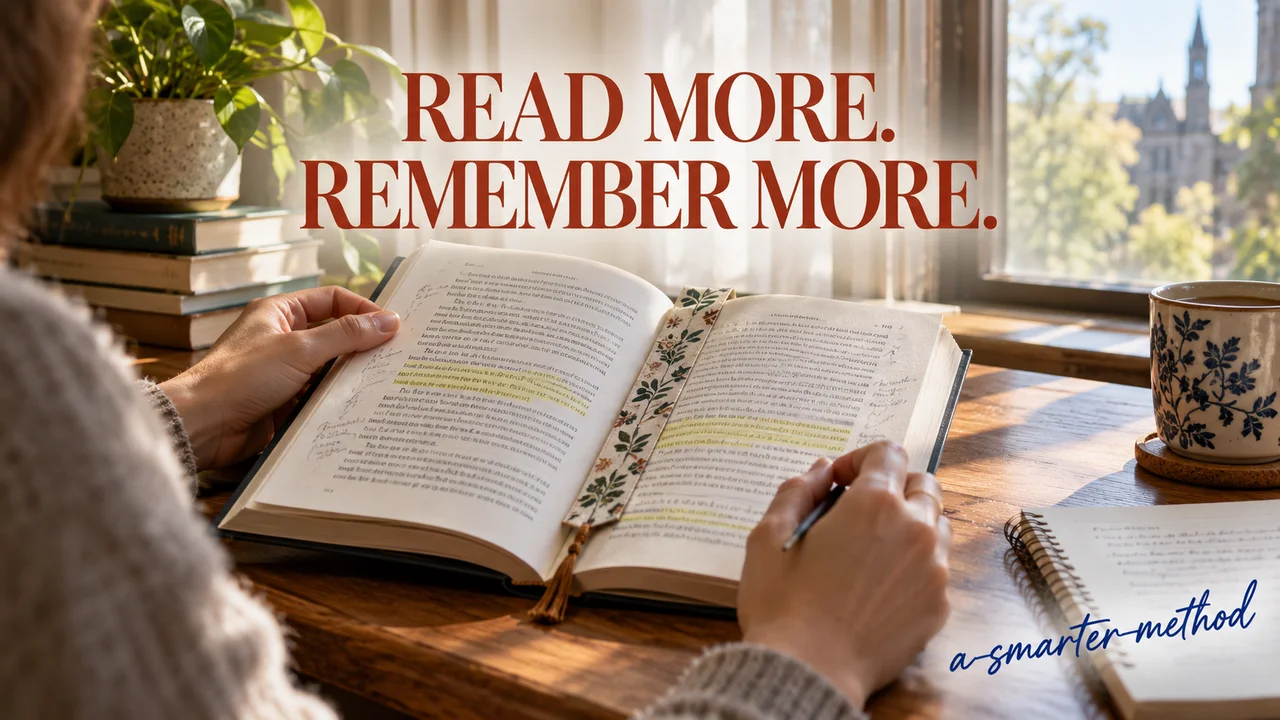
You open a history book, meet "historiography" on page two and a footnote that just says "Ibid.", and by chapter four chapter one has gone. Neither problem is yours. The book speaks a trade dialect.
Below: the words worth translating, the order to read in, and one habit that makes the content stay.
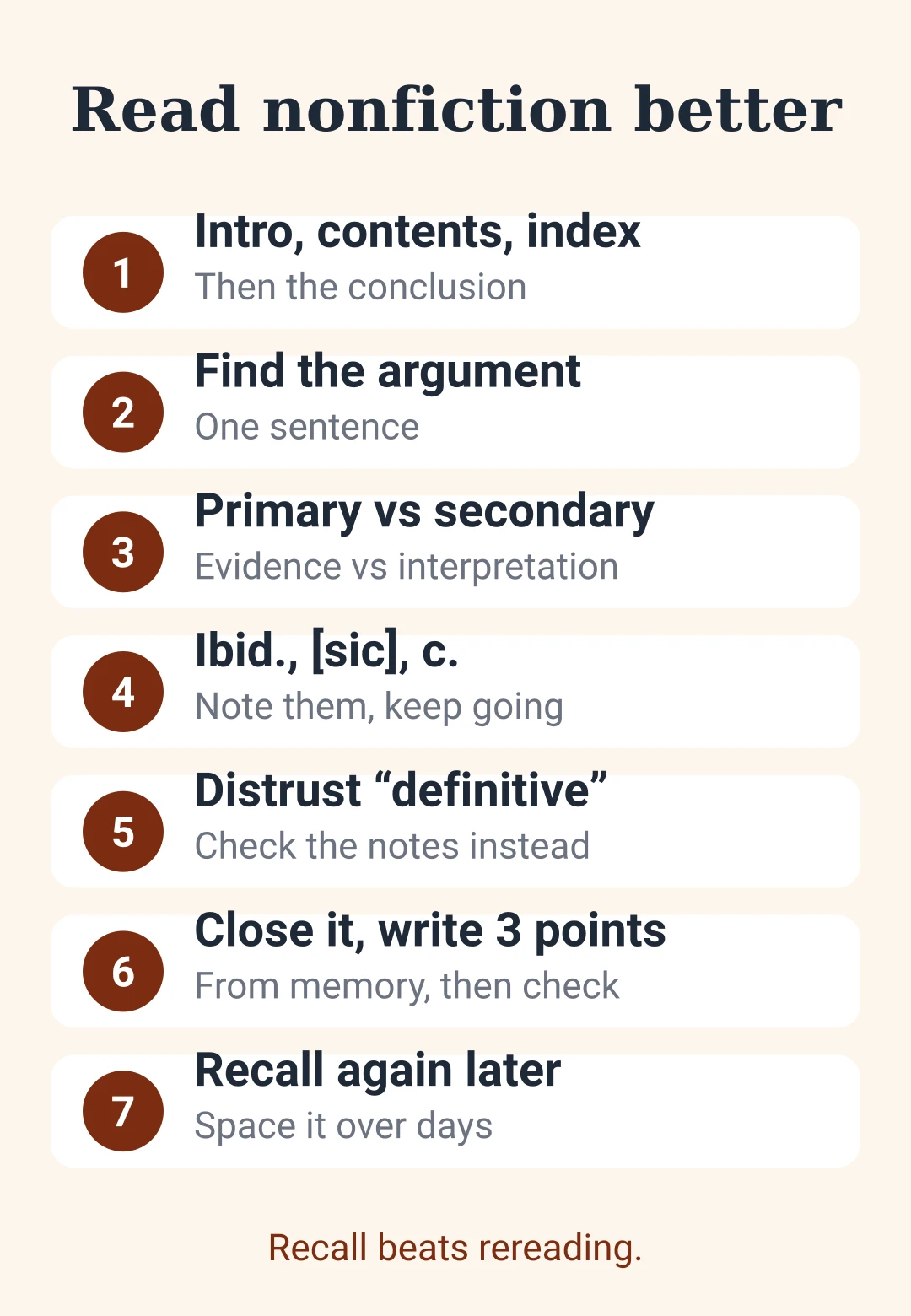
Read in this order
- Title page and introduction. A good historian states the argument here.
- Contents. The chapter titles are the argument's skeleton.
- Index. Glance at the longest entries; they show what the book really spends its time on.
- Conclusion. Reading it first is not cheating. It is how historians read.
- Chapters. Read the ones that carry the argument closely; skim the rest without guilt.
Steps one to three are what Mortimer Adler's How to Read a Book calls "inspectional reading".
Eight words, translated
- The argument (or thesis): the one claim the whole book defends. Can't say it in a sentence? Reread the introduction, not the book.
- Primary source: evidence made at the time, such as a letter, diary, census or photograph.
- Secondary source: a later work that interprets primary sources.
- Historiography: the history of how historians have written about a subject. A chapter with this label tells you who the author is arguing with.
- Monograph: a detailed study of one narrow subject. Expect depth, not plot.
- Ibid.: Latin for "in the same place": the same source as the note before.
- [sic]: "thus". The odd spelling was in the original.
- c. and fl.: circa, an approximate date, and floruit, "flourished": when someone was active, often given when their birth and death are unknown.
What to note, what to skip
Three of these shape how you read: the argument, primary source, historiography. Together they tell you what is claimed, on what evidence, and against whom. The rest? Pass over them.
False friends
"Primary" does not mean "most important"; it means "from the time". A rambling diary is primary, and a brilliant biography is secondary. And "historiography" is not a grand word for "history". It is history's own reading list. Argued over, naturally.
Beware of "definitive"
I'd retire this word from book jackets. No history is definitive; new evidence and new questions keep arriving. Check the notes and bibliography instead. Footnotes make a book more trustworthy, not less readable.
Make it stay
Hidden tip: at the end of a chapter, close the book and write three points from memory, then check. In a well-known study by Roediger and Karpicke, students who recalled a passage remembered more a week later than students who reread it, even though the rereaders felt more confident.
Then space it out: recall again a few days later. A major review of study methods by Dunlosky and colleagues rated self-testing and spaced practice highly, and rereading and highlighting low. I keep an index card in every book for exactly this.
Translate this one
"A monograph drawing on parish registers (c. 1830–1860), revising the historiography of rural poverty." In plain English: a detailed book built on records written at the time, arguing that earlier historians got rural poverty wrong.
Cheat sheet
| When | Do this |
|---|---|
| Before | Intro, contents, index, conclusion |
| Find | The argument, in one sentence |
| Watch | Primary vs secondary evidence |
| Skip | Ibid., [sic], c.: note and move on |
| Distrust | "Definitive" on the jacket |
| After | Close it, write 3 points from memory |
| Later | Recall again a few days on |










コメントするにはしてください。
読み込み中…