
🔬 How to Read a Skincare Ingredient List
Mei Lin · 35 vues · il y a 1 mois · Article
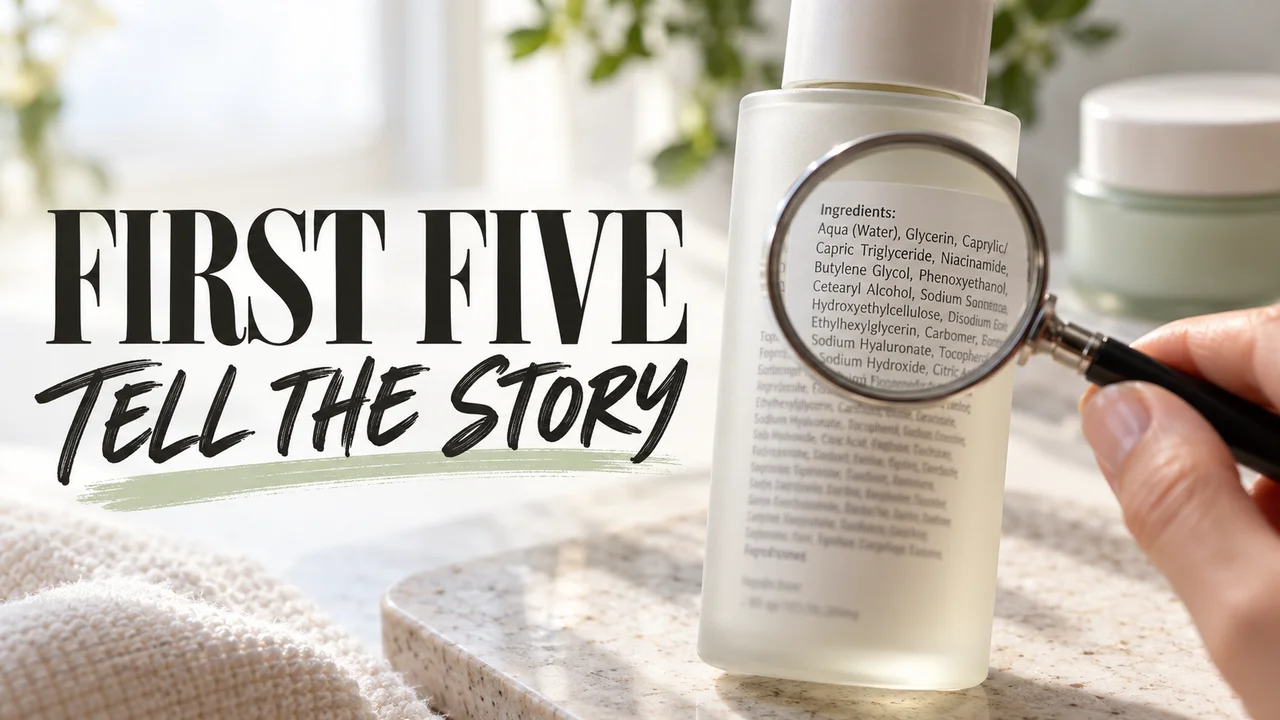
How ingredient order works, where the 1% line sits, and how to spot extracts that are mostly there for the label, with a cheat sheet to save.
The front of the bottle promises green tea, rice or a rare flower. The back lists thirty names in tiny print, and most of us turn it straight back around.
Here is how ingredient order works, where the 1% line sits, and how to tell an extract doing real work from one that's there for the label.
Before: reading the front
Pick the bottle with the prettiest plant, trust the word "with", never check where that plant appears on the back. We end up comparing marketing, not formulas.
After: a 30-second read of the back
Read the first five names. Find the 1% line. Then see which side of it the star ingredient lands on.
It's not a lab analysis; it is an honest sketch of what's in the jar.
Rewind: how the order works
Canada, the US and the EU share the same basic rules:
- Biggest first. Ingredients go in descending order by weight.
- 1% or less: any order. Below that point, the maker can shuffle them.
- Colours last. Any order at the end, often as "CI" numbers.
- Fragrance as one word. "Parfum" or "fragrance" can stand for the whole blend.
So the top five usually make up most of the product. In a toner, that's often water plus glycerin or butylene glycol; the ratio of those is the real texture story.
Finding the 1% line
Labels don't print the line, so we use a landmark.
Hidden tip: the EU allows phenoxyethanol, a widely used preservative, at no more than 1%. Since everything above 1% must come first, any name after it is at 1% or less.
Extracts that are just for show
Let's look at why a famous extract can do so little. Listed after the preservative, it shares the 1%-or-less group with thickeners and pH adjusters. Some ingredients work at small amounts, so that spot isn't proof of nothing. It does mean the front label is louder than the formula.
Hidden tip: extracts are often made by soaking the plant in water, glycerin or a glycol. Those carriers are declared as separate ingredients, so a plant name near the end may be a drop of something already diluted.
One more tail clue: linalool or limonene. These fragrance allergens must be named once they pass 0.001% in leave-on products and 0.01% in rinse-off ones under EU rules, and Canada's rules use the same thresholds. Handy if scent bothers you.
I'd trust a short, boring list from a careful formulator over a long one with trendy extracts at the bottom. Call it a solution to the problem.
The real difference
It isn't knowing every name; it's knowing where to look. Start with the first five and the preservative.
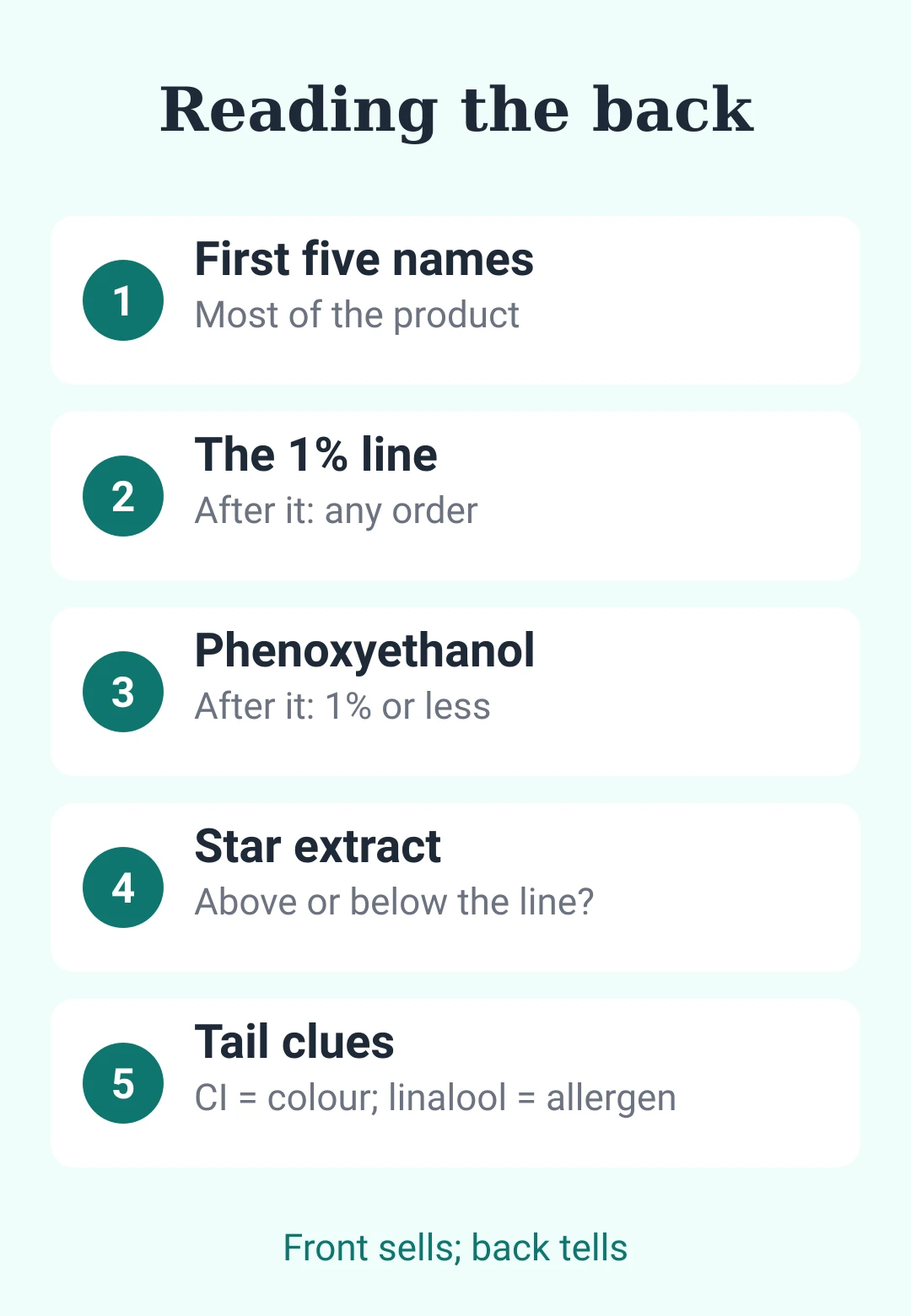
Cheat sheet: reading the back
| Check | What it tells you |
|---|---|
| First five names | Most of the product |
| Order | Largest amount first |
| 1% line | After it: any order |
| Phenoxyethanol | EU cap 1%; after it is 1% or less |
| Star extract | Above or below the line? |
| Carriers | Water, glycerin, glycols listed apart |
| CI numbers | Colours, any order at the end |
| Linalool, limonene | Fragrance allergens |
- ingredient list
- skincare labels
- INCI
- 1% line
- plant extracts
- phenoxyethanol
- fragrance allergens
- skincare basics
Vous avez aimé cette publication ?
pour laisser un commentaire.
Chargement…