
How to Layer Lighting in a Room: Ceiling, Wall and Table Lamps 💡🛋️
Olivia Bennett · 41 vistas · hace 1 mes · Artículo
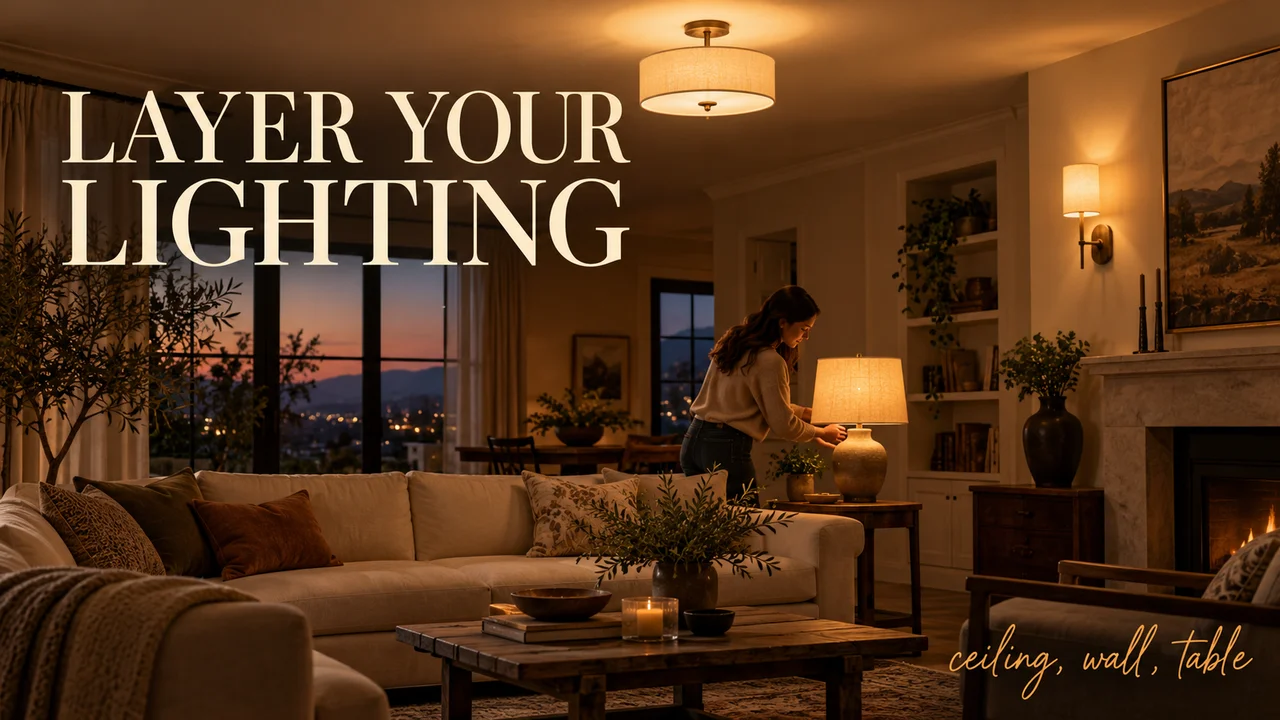
Five common lighting myths put on trial, plus a room-by-room plan for where ambient, task and accent light should sit, with a scorecard to save.
You flip the switch, the ceiling light flattens everything into gray glare, and a room that looked fine at noon feels like a waiting room. Lighting advice gets passed around so often it sounds like fact; a few pieces of it even are.
Below: five lighting myths on trial, then a room-by-room plan.
Myth 1: "One good ceiling light is enough"
Verdict: false. Designers plan light in three layers: ambient (the overall glow), task (focused light for reading, chopping, working) and accent (light on a plant, shelf or picture). An overhead fixture covers only the first.
Why people believe it: one fixture is often the only light a rental comes with (one switch by the door, so it feels like the whole plan), and it's the most common reason a rental feels sad.
Myth 2: "A gloomy room needs a brighter bulb"
Verdict: mostly false. A brighter bulb in the same spot is the same flat light, only louder. Spread it across three heights instead: ceiling, table, floor or wall.
Hidden tip: an accent only works when it outshines its surroundings. The American Lighting Association's rule of thumb is about three times as bright, so a small lamp by a plant shines most in a dimmed room.
Myth 3: "Lamps are just decoration"
Verdict: false. Lamps are your task layer. For reading, set the bottom of the shade around eye level when seated; light lands on the page, and the bulb stays out of your eyes.
Myth 4: "Wall lights mean calling an electrician"
Verdict: half-true. Hardwired ones do. Plug-in sconces run to an outlet, often behind a cord cover. (Renters, put the drill down and check what your lease allows.) Most guides hang them about 60 to 72 inches from floor to fixture center.
Myth 5: "Any LED bulb works on a dimmer"
Verdict: false. Many LEDs aren't designed to dim and can flicker or buzz. Use bulbs marked "dimmable" and use an LED-compatible dimmer; old incandescent-era dimmers often handle LEDs badly.
A dimmer lets one room switch from bright work to a warm pool of light. ENERGY STAR puts incandescent-like warm white at about 2200 to 3000K (lower looks more yellow). Keep one room's bulbs close in number so the lamps don't argue.
Hidden tip: older eyes let less light through the lens. The Lighting Research Center suggests at least 50% more general light for older adults, glare kept down. Give a parent's reading chair the strongest lamp.
Where each layer sits, room by room
| Room | Ambient | Task and accent |
|---|---|---|
| Living room | Ceiling or uplighting floor lamp | A lamp by each seat; one accent |
| Bedroom | Dimmed ceiling or floor lamp | Bedside lamps or plug-in sconces |
| Kitchen | Ceiling fixture | Under-cabinet strips over the counter |
| Desk | Ceiling or floor lamp | Desk lamp on the work |
| Hallway | Ceiling light | Sconces 60 to 72 in. up |
In my rented living room (still zero holes), a thrifted rattan lamp outworks the ceiling fixture.
Scorecard: save this
| Myth | Verdict | Do this instead |
|---|---|---|
| Ceiling light is enough | False | Ambient, task, accent |
| Brighter bulb fixes gloom | Mostly false | Three heights; accents ~3x brighter |
| Lamps are decoration | False | Shade at seated eye level |
| Wall lights need wiring | Half-true | Plug-in sconces, 60 to 72 in. |
| Any LED dims | False | "Dimmable" bulb, LED dimmer, 2200 to 3000K |
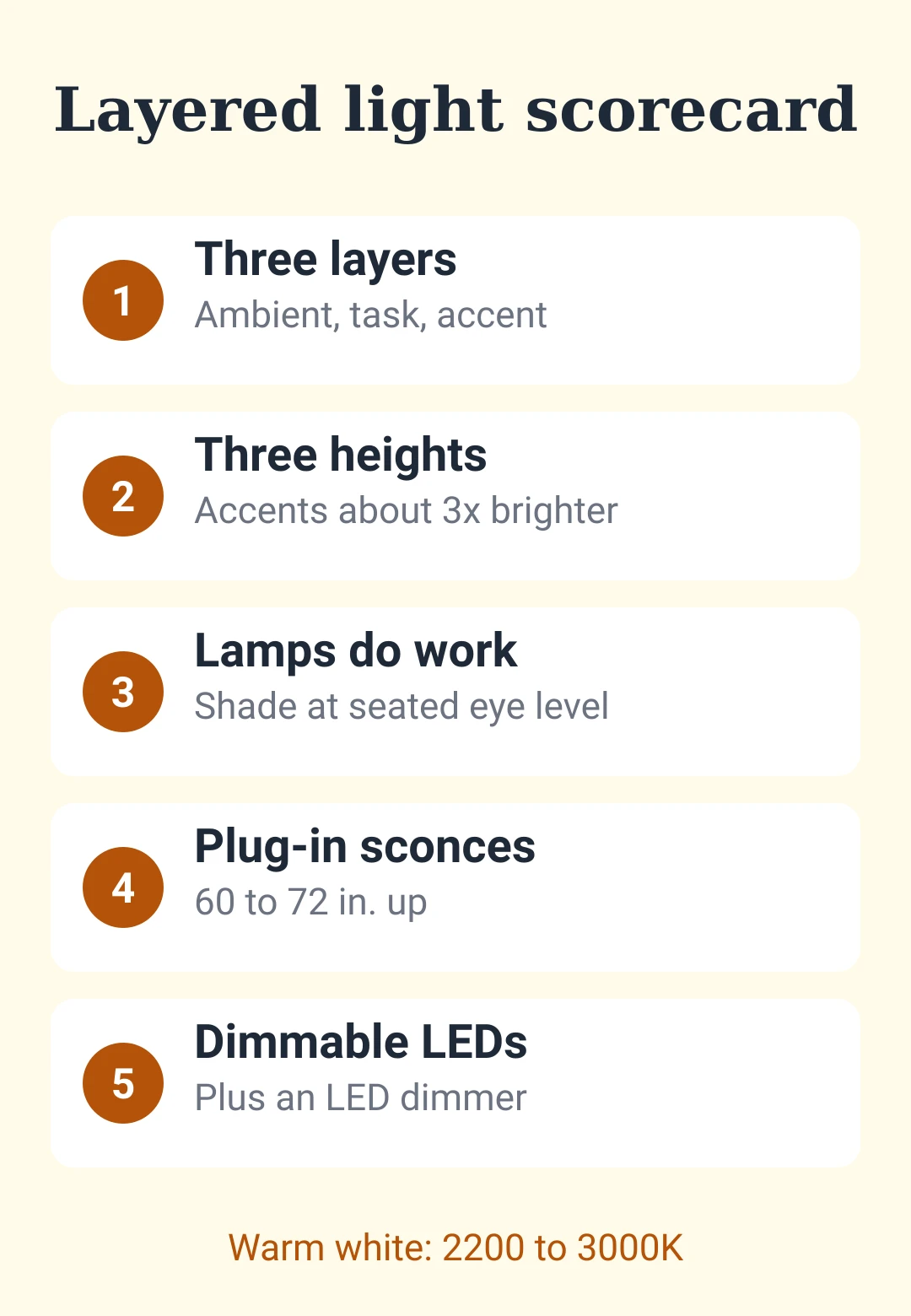
Three myths sank, two got a reprieve. Keep one rule: light at three heights, the ceiling only one of them.
- lighting
- layered lighting
- table lamps
- wall sconces
- ceiling lights
- dimmers
- renter friendly
- living room
¿Te gustó esta publicación?
para dejar un comentario.
Cargando…