
How to Stop Your Dog Pulling on the Lead: 6 Steps 🦮
Ollie Grant · 40 Aufrufe · vor 4 Monaten · Artikel

A six-step loose-lead training plan that works with the lead you already have, two lesser-known tips from UK dog charities, and a cheat sheet to save.
Fiona from Dennistoun writes: "My arm's about to come out its socket." Anyone towed down a pavement by their own dog knows the feeling.
Here's a six-step loose-lead plan that works with the lead you already have, plus a cheat sheet worth keeping.
The letter
"Rolo, my two-year-old chocolate Lab cross, drags me the whole way to the park. I've tried pulling him back and shouting 'heel'. I even tried a squeaky ball. Nothing. The worst bit is mornings, when I'm rushing to get him out before my shift. In the park he's an angel. Is he just stubborn, or is it me?" — Fiona, nurse on early shifts, Dennistoun
Reading between the lines
The answer's in your letter, Fiona: "rushing to get him out." You hurry, Rolo pulls, you keep walking. So pulling works. PDSA lists exactly this habit as a common cause.
Short version: Rolo isn't stubborn. He's learned that a tight lead means go. Teach him it means stop.
The six steps
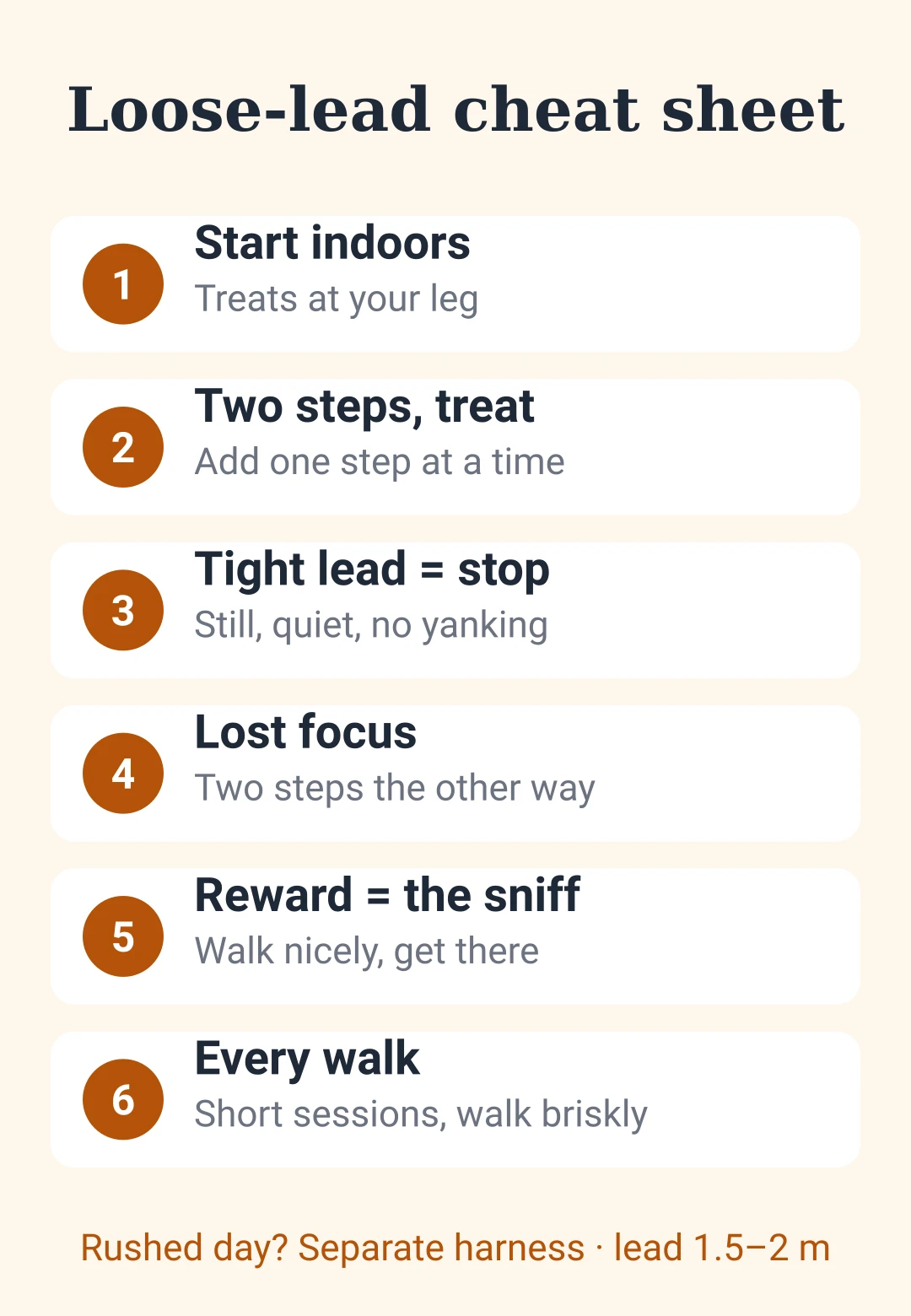
- Start indoors. Hallway or garden, lead in one hand, treats in the other. Reward him for standing by your leg, away from distractions (Dogs Trust starts here).
- Two steps, then a treat. Walk two steps. Slack lead? Say "yes!", treat at your side, then add a step.
- Tight lead? Stop. Stand still, stay quiet, no yanking. Move on once the lead goes slack.
- Staring at a squirrel? Take a couple of steps the opposite way to get his focus back.
- Make the thing he wants the reward. Walk nicely to the lamppost, get to sniff the lamppost. The RSPCA does the same with a toy on the floor — pull and you stop, walk nicely and you get it.
- Every walk, short sessions. The RSPCA says short and regular.
Hidden tip 1: walk faster. Woodgreen tells owners to walk briskly during training, because dogs naturally move faster than people. (Bruce, my terrier cross, treats every walk as a race.)
Hidden tip 2: two clips, two rules. For days you can't train, Dogs Trust suggests one harness where pulling is allowed, and a different harness or the collar clip for training walks. Dogs learn the difference.
In your shoes
- Skip training on the morning dash — "rushing" harness on, park, no bother.
- Do steps 1–3 in the hallway after your shift, after a good play — PDSA suggests a long play session first.
- Swap the squeaky ball for wee treats like boiled chicken or carrot slices (PDSA again), and trim his dinner on training days.
- Your lead's fine — Woodgreen suggests 1.5–2 m.
For everyone else
Same rule for any puller, puppy or old-timer: a tight lead never gets them anywhere. RSPCA Queensland discourages extendable leads, which teach pulling, and suggests a front-attaching harness with a double-ended lead for persistent pullers.
Cheat sheet: loose-lead walking
| Step | Do this |
|---|---|
| Start | Indoors, treats at your leg |
| Build | Two steps, treat, add one |
| Tight lead | Stop, stay quiet, no yanking |
| Lost focus | Two steps the other way |
| Reward | Let him reach the sniff spot |
| Routine | Every walk, short sessions |
| Pace | Walk briskly |
| Rushed days | Separate "pulling" harness |
| Lead | 1.5–2 m, no extendable yet |
So, Fiona: Rolo isn't stubborn, he's clever. Let me know how he gets on in that hallway.
- dog training
- loose lead walking
- dog pulling
- lead training
- dog walking
- harness
- positive reinforcement
- how to
Hat dir dieser Beitrag gefallen?
, um einen Kommentar zu hinterlassen.
Wird geladen…